
Checked in September 2026. Read enough Korea travel advice and it starts to contradict itself. One traveler barely touched cash. Another says T-money sent them looking for an ATM. Someone paid for nearly everything with Apple Pay; someone else walked from ATM to ATM with a perfectly good foreign card.
They are all partly right. Korea in 2026 is an easy country to travel with a foreign card — but “cards work almost everywhere” is not the same as “you will never need cash.”
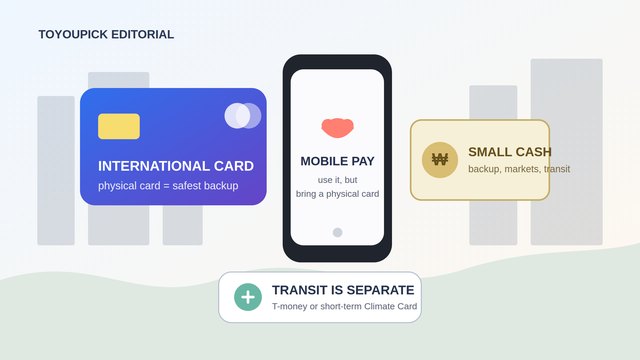
The short answer: bring one physical international card, keep your usual phone wallet, carry a little Korean won as backup, and choose one transit option before you arrive.
At a glance: what works where
| Where you pay | Foreign card | Apple Pay / Samsung Wallet | Cash | Transit card / notes |
|---|---|---|---|---|
| Hotels | ◎ | ○ | ○ | — |
| Convenience stores | ◎ | ○~◎ | ◎ | T-money accepted |
| Cafés and restaurants | ◎ | ○ | ○ | — |
| Chains and fast food | ◎ | ○~◎ | ○ | — |
| Department stores and malls | ◎ | ○~◎ | ○ | — |
| Palaces, museums, big attractions | ◎ | ○ | ○ | Online booking may need extra steps |
| Traditional markets, street food | △ | ✕~△ | ◎ | — |
| Small local shops | ○ | △ | ○ | — |
| Seoul subway gates and buses | ✕ | ✕ | △ | T-money / short-term Climate Card |
| New Seoul subway ticket machines | ◎ | △ | ◎ | Short-term Climate Card, single tickets |
| Topping up a physical T-money | ✕ | ✕ | ◎ | Cash |
| iPhone MobileTmoney top-up | △ | △ | — | Some card brands only |
| Global ATM cash withdrawal | △ | — | — | Depends on your card and bank |
◎ widely accepted · ○ usually fine · △ depends on the place or card · ✕ do not count on it. This is a practical guide, not a guarantee — the card issuer, the terminal and the app version can all change the result.
Hotels, convenience stores, cafés and shopping are easy with a card. Where visitors get stuck is transit, plus some markets and very small shops.
Can I just bring dollars?
A little foreign cash as emergency money is fine. But everyday prices in Korea are in won (KRW), and cafés, restaurants and convenience stores will not take dollars — or euros, or any other currency — at the counter.
Treat foreign cash as something you can exchange at a bank or licensed money changer if you need to, not as spending money. There is no need to carry your whole budget in cash.
Is a foreign card enough?
For most daily spending, yes. Visa, Mastercard and American Express are widely accepted at hotels, department stores and ordinary shops, and recent traveler reports match that: accommodation, cafés, restaurants and shopping mostly go on a home-issued card.
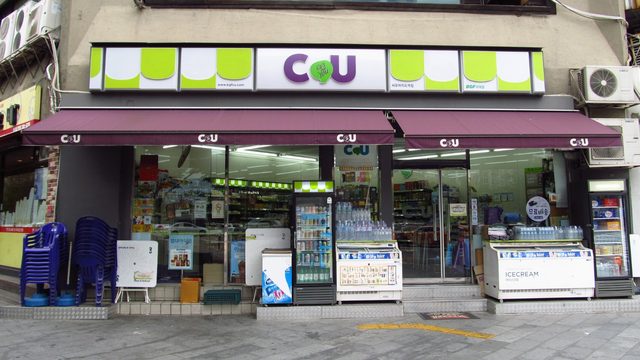
The key word is “most.” A valid foreign card can still be declined by one particular terminal, and market stalls or tiny shops are often easier with cash.
So the simple setup is not “card only.” It is one physical card you trust, plus your phone wallet and a little won as backup.
Can I withdraw won from an ATM?
Yes. Many visitors arrive with little cash and withdraw what they need after landing.
Not every ATM works with every foreign card, though. One traveler this year tried several machines in Seoul before finding the real problem: their own bank had overseas transactions switched off.
Before you fly, check one thing: is my card enabled for overseas purchases and ATM withdrawals? In Korea, look for ATMs marked “Global” or for foreign cards.
Is Apple Pay useful in Korea now?
Older travel posts made Apple Pay sound almost useless in Korea. That is out of date. Acceptance has grown at convenience stores, big retailers and chains, and some visitors now use it for most of their purchases.
Apple Pay not working at a shop does not mean your foreign card won’t work there.
Some terminals take a physical Visa or Mastercard but not a phone wallet. If you use an iPhone, bring the physical card too.
What about Samsung Wallet?
Samsung Wallet is everywhere in Korea — for Koreans using Korean cards. A visitor with a card issued abroad is a different case: support depends on the issuing country, the bank and the card.
Rather than assuming your Galaxy will simply work, check before you travel whether your own card supports Samsung Wallet payments abroad.

Why does transit suddenly get complicated?
You pay by card at a convenience store, walk into the subway, and discover that the same card is not what you tap at the gate.
As of September 2026, you cannot count on tapping a regular foreign Visa or Mastercard at a Seoul subway gate or bus reader. Visitors still use a transit card: T-money, or the short-term Climate Card in Seoul.
Why do people still say T-money needs cash?
T-money is a rechargeable transit card that works on buses and subways in Seoul and many other cities, so it is the simple choice if you are visiting more than one place.
The awkward part is topping it up. For a regular physical T-money card, cash is still the safe assumption — which is how “Korea is cashless” and “I needed cash for T-money” can both be true.
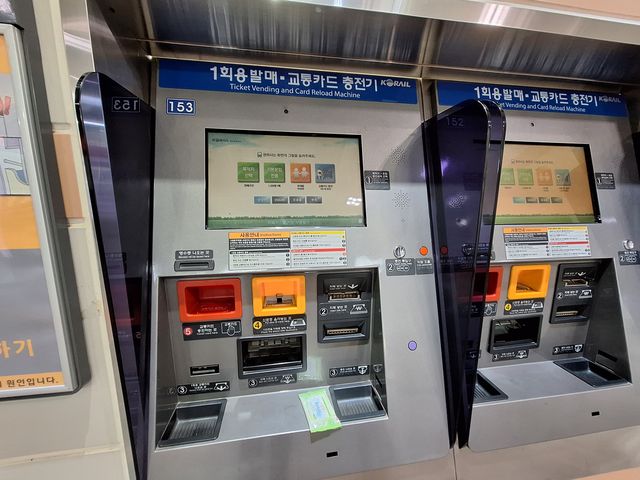
Staying in Seoul? The short-term Climate Card may be easier
Since March 17, 2026, 440 new ticket machines at 273 stations on Seoul Subway Lines 1–8 accept internationally issued credit and debit cards, such as Visa and Mastercard.
At those machines you can buy a short-term Climate Card (1, 2, 3, 5 or 7 days) or a single-journey ticket with your foreign card. International cards carry a service fee of about 3.7%.
Buying a Climate Card with your foreign card is not the same as tapping that card at the gate.
The older 30-day Climate Card ends at the end of September 2026. The 1- to 7-day passes that visitors use continue.
iPhone: T-money on your phone — check the card brand
iPhone and Apple Watch users can add T-money to Apple Wallet through the MobileTmoney app. Tapping the “Foreigner” button skips Korean sign-up and lets you top up with a card issued abroad.
But as of September 2026, that top-up accepts Mastercard, American Express, UnionPay and JCB — not Visa. If Visa is the only card you are bringing, plan on a physical T-money or a Climate Card instead.
On Android, Seoul points visitors to Tmoney’s Korea Tour Card app, which can be topped up with a foreign card.
Do I need WOWPASS or another tourist card?
Not necessarily. Tourist cards bundle currency exchange, payment and transit, and some travelers like that. If you already have a card that works well abroad with reasonable fees, another card is optional — for some people it is just one more balance to manage.
Transit is getting easier — from 2027
In September 2026, Tmoney signed an agreement with Visa, Mastercard, UnionPay, JCB and Hana Card to build an EMV open-loop system: tap the contactless card you use at home, no transit card needed. It is planned for Seoul city buses in 2027, followed by Incheon and airport buses.
Seoul’s plan also includes new terminals on subway Lines 1–8 from 2027. Until that happens, do not arrive expecting your own card to work as a fare card.
What to bring
- One physical international card. Visa or Mastercard is the simplest. Check overseas use and foreign-transaction fees before you leave.
- Your usual phone wallet — Apple Pay or Samsung Wallet — with the physical card as backup.
- A little Korean won for markets, street food, T-money top-ups and the occasional declined card.
- One transit option: a short-term Climate Card for a Seoul-only trip, T-money if you are visiting several cities.
The bottom line
You can pay for most of a Korea trip by card. Transit is the one thing to sort out separately.
Use your card as normal, plan transit on its own, and keep a little cash as insurance. Payment rules and supported cards change, so check the official links below shortly before your trip.