
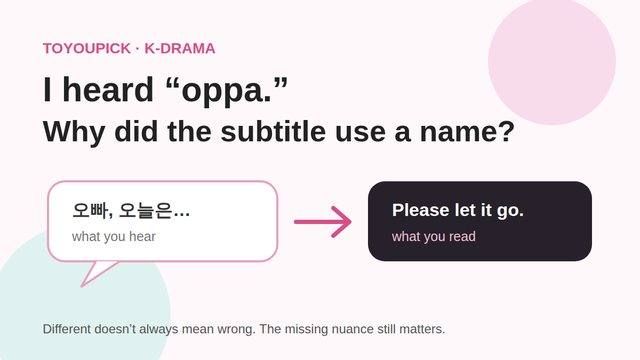
After a few K-dramas, your ears start catching things before your Korean does. An actor delivers a long, emotional line and the subtitle answers with six calm English words. Someone clearly says *oppa*, yet a name appears on screen.
Did the subtitles quietly rewrite the scene?
Usually, no. Different does not automatically mean wrong. Subtitles are translations, but they are also tiny pieces of timed editing. They must fit on screen, stay long enough to read and leave before the next line arrives. Still, shortening a sentence is not the same as changing its meaning—and that difference matters.
The actor is still talking. The subtitle is already full.
Netflix’s English timed-text guide allows up to 42 characters per line, a maximum of two lines and an adult reading speed of up to 20 characters per second. If subtitles tried to keep every hesitation and repetition, you would finish reading just in time to miss the actor’s face.
So a long line gets packed like an overfilled carry-on. Repetition goes first. Information already visible in the scene may be folded away. Korean word order is rebuilt into English that can be understood at a glance.
The real question is not whether something was removed. It is what the subtitle chose to leave behind.
How “oppa” becomes one short English line
Here is a fictional scene created for this article. A woman is quietly asking an older man she is close to for a favor.
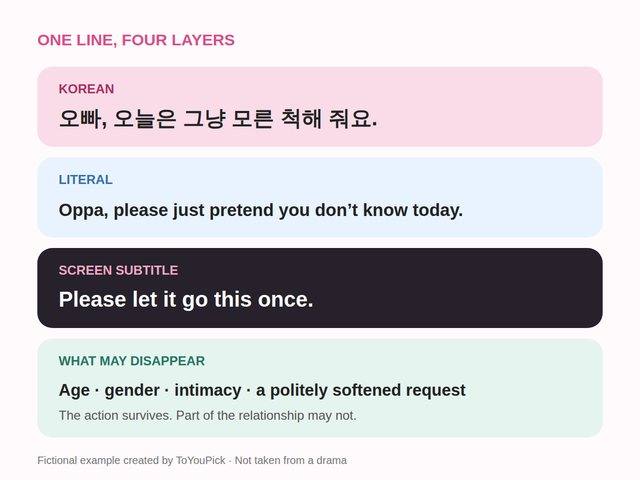
| Stage | Line |
|---|---|
| Korean | 오빠, 오늘은 그냥 모른 척해 줘요. |
| Literal | Oppa, please just pretend you don’t know today. |
| Screen subtitle | Please let it go this once. |
The screen subtitle is easy to read. It keeps the request and the feeling of “just this once.” The translation has not wandered into another drama.
But *oppa* and the polite *-줘요* ending carried extra luggage: age, gender, closeness and a carefully softened tone. The message arrived. Part of the relationship missed the flight.
Why translators replace *oppa* with a name
*Oppa, eonni, hyung* and *noona* place two people by age, gender and intimacy. *Sunbae* reveals seniority at school or work. Add Korean speech levels and a tiny ending can move a relationship closer, colder or suddenly unequal.
English has no compact address system that carries the same bundle. “Older brother” may falsely suggest a biological sibling. Keeping *oppa* may leave a first-time viewer wondering whether a new character just entered the room. A translator may choose a name, “you,” a title or an affectionate English term instead.
That choice is not automatically wrong. It hurts most when the form of address is the event—when someone drops polite speech for the first time, or finally says *oppa* after ten episodes of emotional traffic.
Jokes and dialects lose the race against timing
A Korean pun may depend on two words sounding alike. Explain it in English and the moment to laugh has already passed. A dialect can signal region, age and personality, but replacing it with a familiar English-language regional accent may introduce a completely different stereotype.
Translators often rebuild the joke or suggest personality through rhythm and register. If the words change but you still laugh at the same person for the same reason, the scene travelled well. If the target of the joke or the character’s attitude changes too, smooth English may have flattened the character.
English or English CC on Netflix?
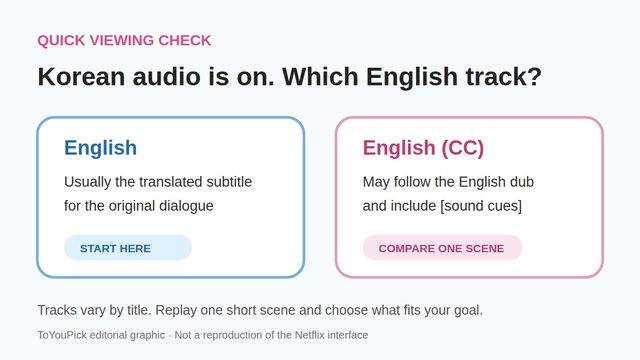
If you are listening to Korean and see both English and English (CC), try English first when your goal is to stay closer to the Korean dialogue.
Regular English is generally the translated subtitle track. On a dubbed title, English CC may follow the English dub and include cues such as [door closes]. That can make it feel noticeably farther from what the Korean actors are saying.
It is not a universal rule for every title. Replay ten seconds with each track and choose the one that fits what you want. This is not a subtitle exam. It is simply choosing the better doorway into the scene.
Why Viki subtitles can feel different
Viki says its subtitles are made by contributor teams that include subtitlers, segmenters, editors, moderators and managers. Depending on the show, a team may keep words such as *oppa* or *sunbae* and explain cultural context more openly. For viewers who already speak a little K-drama, that can feel wonderfully considerate.
Netflix usually writes for a broad global audience, including people meeting Korean relationship terms for the first time. Neither system guarantees perfect subtitles. Quality can change with the title, team, language, region and available version.
Rakuten Viki official channel — How Subtitles are Created on Rakuten Viki
When a subtitle really does feel wrong
- If the sentence is shorter but who did what and why remains the same, it is probably localization.
- If a filler disappears but the emotion still points in the same direction, reading speed may be the reason.
- If a request becomes an order, past becomes future, or “I didn’t” becomes “I did,” question it.
- If a missing honorific hides a plot-important relationship change, compare another licensed subtitle.
- Read the line before and after it. Subtitle meaning sometimes travels across two cards.
You do not need to study Korean full-time. Learn *oppa, eonni, hyung, noona* and *sunbae*, and entire relationships begin appearing between the English words. When one line still seems wrong, compare the same cut on another licensed platform or check a reliable Korean explanation. A random fan clip or AI subtitle is not automatically the final authority.
Subtitles are not copies of dialogue. They are small doors carrying a scene into another language while fighting the clock. Sometimes the handle squeaks. But once you know why *oppa* disappeared, you may start hearing the relationship in the space it left behind.