
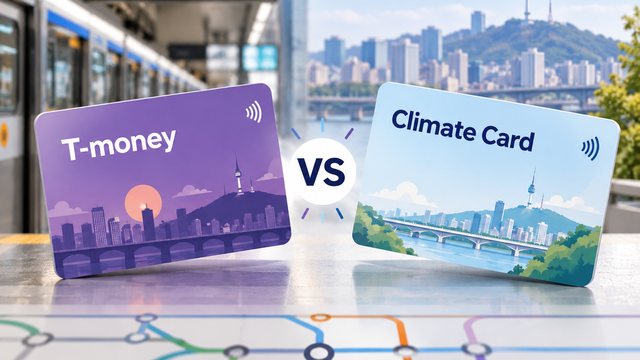
Most visitors to Seoul end up choosing between two transit cards: T-money, which deducts a fare every time you ride, and the Climate Card short-term pass, which gives you unlimited Seoul subway and bus rides for a set number of days.
Short answer: if you’re leaving Seoul at any point, get T-money. If you’re staying in Seoul and moving around a lot every day, the Climate Card can save you money. Not sure? T-money.
The 10-second decision
| Your trip | Get |
|---|---|
| Seoul + Busan, Gyeongju or Jeju | T-money |
| Seoul only, one or two places a day | T-money |
| Seoul only, several neighborhoods a day | Climate Card |
| A concert at KINTEX (Goyang) or Inspire Arena (Incheon) | T-money |
| Plans not settled yet | T-money |
How they differ
| T-money | Climate Card short-term pass | |
|---|---|---|
| How you pay | Fare deducted per ride | Unlimited rides for 1–7 days |
| Where it works | Buses and subways across most of Korea, plus convenience stores | Seoul subway and Seoul buses (not the Shinbundang Line or GTX) |
| Card price | About ₩3,000–5,000, depending on design | ₩3,000 |
| Top-up | Any amount, usually cash | 1, 2, 3, 5 or 7-day pass, at subway station machines |
| Foreign card | Physical card: cash only in practice | Yes, at new machines on Seoul Lines 1–8 |
| Busan and other cities | Works | Doesn’t work |
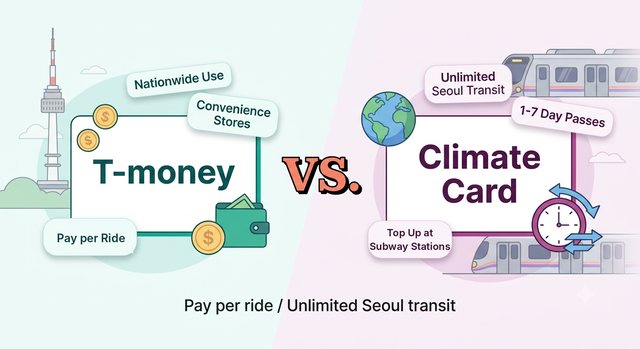
T-money: the safe default
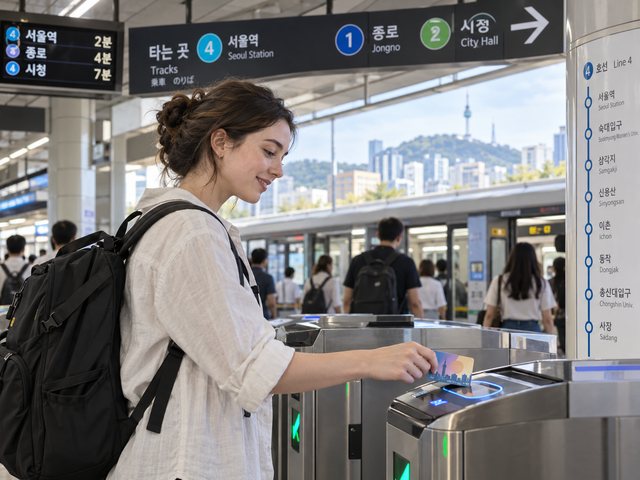
Buy the card, load money, then tap the reader when you get on and when you get off. On buses, tap again when you get off — skip that and you lose the transfer discount on your next ride.
With a transit card, the base fare is ₩1,550 on the Seoul subway and ₩1,500 on Seoul city buses. Switch between bus and subway within 30 minutes of getting off and you don’t pay a new base fare — only a little extra for longer distances.
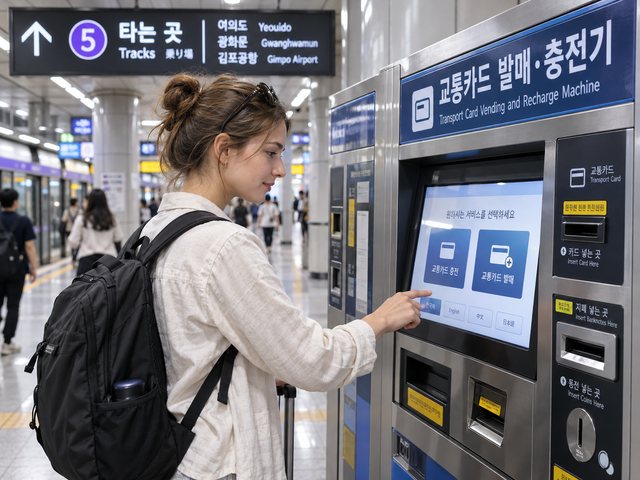
You buy and top up T-money at convenience stores (GS25, CU, 7-Eleven, emart24) and at subway stations. Plan on topping up a physical card with cash. iPhone users can add T-money to their phone with the MobileTmoney app, but Visa cards can’t be used to top it up — details in our cash and payments guide.
Already have a traveler card like WOWPASS? It has T-money built in, so you don’t need a separate T-money. Just note that the transit balance is topped up separately from the payment balance — for getting around, it works exactly like T-money.
Climate Card: pays off the more you ride in Seoul
The Climate Card short-term pass is made for visitors. For the days you choose, you can ride the Seoul subway and Seoul buses — village buses and night buses included — as many times as you like.
| Pass | Price |
|---|---|
| 1 day | ₩5,000 |
| 2 days | ₩8,000 |
| 3 days | ₩10,000 |
| 5 days | ₩15,000 |
| 7 days | ₩20,000 |
Buying the physical card for the first time adds ₩3,000. So a first-timer’s 5-day pass comes to ₩3,000 + ₩15,000 = ₩18,000.
You can buy the card at subway station machines or convenience stores, but the pass itself is loaded at subway station machines. The new machines on Seoul Lines 1–8 accept foreign Visa and Mastercard, with a service fee of about 3.7%.
The 30-day pass that Seoul residents used ended in September 2026. The short-term passes for visitors are still running.
How many rides to break even?
Using the ₩1,550 subway base fare as a simple yardstick:
| Pass | Price | Break-even rides |
|---|---|---|
| 1 day | ₩5,000 | 4 (4 a day) |
| 2 days | ₩8,000 | 6 (3 a day) |
| 3 days | ₩10,000 | 7 (2–3 a day) |
| 5 days | ₩15,000 | 10 (2 a day) |
| 7 days | ₩20,000 | 13 (2 a day) |
So the 5- and 7-day passes roughly pay for themselves if you make two separate trips a day. The 1-day pass only wins if you ride four or more times that day.
Count trips, not taps. A bus-to-subway transfer on T-money costs about one fare, not two — count every tap and the Climate Card looks better than it really is.
Example: hotel → Gyeongbokgung → Seongsu → Hongdae → hotel is four trips, which is Climate Card territory. Hotel → Myeongdong → hotel is two trips, and T-money is enough.
Don’t load the pass early
The day you load a short-term pass counts as day one. Arrive at your hotel on Friday night, load a 3-day pass, and Friday is already gone — even if your sightseeing really starts on Saturday. Load it on the morning of your first busy day.
It stops at Seoul’s borders — and the borders got tighter
From October 1, 2026, the short-term pass covers the Seoul subway, Seoul buses and getting off at Incheon Airport on AREX (more below). Sections in Gimpo, Goyang, Gwacheon, Guri, Seongnam, Hanam and Namyangju that used to be included are now out.
Board inside Seoul but get off at a station outside the coverage area, and the Climate Card won’t cover that trip. Heading to KINTEX in Goyang, Pangyo or a concert in Incheon? Carry T-money that day.
The Shinbundang Line and GTX aren’t covered either — not even at stations inside Seoul, such as Gangnam.
Incheon Airport: one direction only
You can ride AREX from Seoul and get off at Incheon Airport Terminal 1 or 2 with a Climate Card. You can’t board at the airport with it to get into Seoul — so on arrival day, you need T-money. This applies to the all-stop AREX train; the express train needs a separate ticket.
The easy order: buy T-money at an airport convenience store, load some cash and ride into Seoul → load a Climate Card on the morning of your busiest Seoul day → take AREX to the airport on your way home.
Ttareungyi bikes and the Han River Bus aren’t included
The short-term pass doesn’t cover Ttareungyi (Seoul’s public bikes) or the Han River Bus. Plenty of online guides still bundle them in — that was the 30-day pass, which has ended.
Traveling with kids
Child fares aren’t applied automatically. After buying T-money, show your child’s passport at a convenience store or station and have their birthdate registered to get child (6–12) or youth (13–18) fares. Children under 6 ride free.
Leftover balance
Small T-money balances can be refunded at convenience stores for a ₩500 fee, but the bigger the amount, the fewer places can refund it. Top up in small amounts and spend what’s left at a convenience store on your last day. Climate Card passes can’t be refunded once they’ve expired.
What fits your trip?
- 3 days in Seoul, hopping between Seongsu, Hongdae, Myeongdong and the palaces every day → Climate Card 3-day pass
- 5 days in Seoul, one neighborhood a day at a slow pace → T-money
- 4 days in Seoul + 3 in Busan → T-money. Add a Climate Card only for unusually busy Seoul days
- A fan trip with a concert in Goyang or Incheon → T-money (Climate Card only for your Seoul days)
- First trip to Korea, plans still open → T-money
Bottom line
T-money is the card that works almost everywhere. The Climate Card is an add-on for days you spend crisscrossing Seoul. Fares and coverage can change, so check the official links below right before you go.