
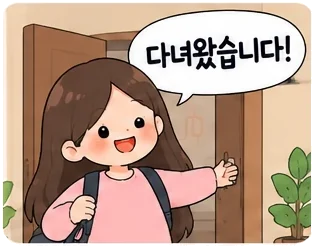
다녀왔습니다
English speakers usually just walk in and say “Hi.” Korean has a set phrase for coming back, and another for leaving, and families actually use them every day.
What does it mean?
다녀왔습니다 (danyeowatseumnida) means “I went and came back”: the Korean way to say “I’m home” or “I’m back.” It is said when you return home, or return to the office from an errand or meeting.
Leaving and coming back
Korean treats leaving and returning as a pair. The ending 겠 (future) vs 왔 (past) makes the difference.
When do Koreans use it?
- At home. Children say it to parents after school; adults too, especially in homes with elders.
- At work. After a meeting, business trip or errand: “회의 다녀왔습니다” (I’m back from the meeting).
- In dorms and homestays. A friendly habit that makes you sound natural to host families.
- Casual version. With friends or roommates: 다녀왔어 or simply 나 왔어.
How it sounds: examples
엄마, 다녀왔습니다!
Eomma, danyeowatseumnida!
“Mom, I’m home!”
회의 다녀왔습니다.
Hoeui danyeowatseumnida.
“I’m back from the meeting.”
다녀왔어? 배고프지?
Danyeowasseo? Baegopeuji?
“You’re back? You must be hungry.”
Pronunciation tip
It sounds like [다녀왇씀니다], “da-nyeo-wat-sseum-ni-da.” The -습니다 ending is said “sseum-ni-da”: ㅂ before ㄴ turns into an m sound.
Say it in one smooth breath; the final 다 drops slightly in pitch.
The nuance
The -습니다 ending is formal, but using it with parents doesn’t sound cold: it is a fixed greeting, like a small family ritual. Many families say it just as naturally as “I’m home!”
Be careful
Don’t mix up the pair: 다녀오겠습니다 when you leave, 다녀왔습니다 when you return. And the formal version with close friends can sound funny: use 다녀왔어.
Similar words: what’s the difference?
Quick check: You leave your homestay in the morning. What do you say: 다녀오겠습니다 or 다녀왔습니다?
다녀오겠습니다. You say 다녀왔습니다 when you come back in the evening.