
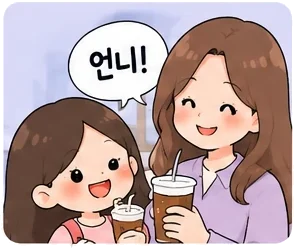
언니
If you watch Korean variety shows, you hear 언니 everywhere: between sisters, friends, even customers and shop staff. The tricky part for learners: only women say it.
What does it mean?
언니 (eonni) means “older sister,” used by a female speaker. Besides her real sister, a woman calls an older female friend, coworker she is close to, or senior eonni. It is warm and familiar, a little like calling someone “sis.”
Who says it to whom?
A man would call the same older woman 누나 (nuna). The word changes with the speaker’s gender, not only the listener’s.
When do Koreans use it?
- Family and friends. Sisters, cousins and close older female friends.
- At shops and restaurants. Customers often call female staff 언니 to sound friendly, and staff sometimes call customers 언니, too.
- Fans. Female fans call older female idols 언니: you’ll see it in comments on K-pop videos.
- Among coworkers. Once colleagues are close, a younger woman may switch from a job title to 언니 outside formal settings.
How it sounds: examples
언니, 이거 어때?
Eonni, igeo eottae?
“Eonni, how does this look?”
언니, 여기 물 좀 주세요.
Eonni, yeogi mul jom juseyo.
“Eonni, could we get some water here?”
Pronunciation tip
언 + 니. The vowel ㅓ is an open “uh” sound, as in “fun”, not “o” as in “on.” The ㄴ at the end of the first syllable flows straight into the second: “eon-ni,” with a slightly long n.
The romanization “eo” trips many learners. Don’t read it as “e-o”: it is one vowel.
The nuance
Eonni carries closeness and a soft hierarchy: the younger speaker shows affection, and the older one is expected to look out for her a little: paying for coffee now and then is a classic eonni move.
Be careful
Men don’t use 언니 for women; they say 누나. Calling restaurant staff 언니 is common in casual places, but some people prefer 저기요 (excuse me) or 사장님 (boss), if unsure, 저기요 is always safe.
Similar words: what’s the difference?
Quick check: A 22-year-old woman talks to her 26-year-old female friend. 언니 or 누나?
언니 (eonni). 누나 is what a man would say.