
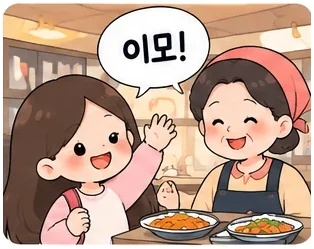
이모
Korean has separate words for aunts on your mother’s side and your father’s side. And 이모 has a second life outside the family: you’ll hear it called out in busy Korean restaurants.
What does it mean?
이모 (imo) is your mother’s sister. Anyone can use it: men and women, children and adults. By extension, it has become a warm way to address a middle-aged woman who feels like family: a mom’s close friend, or the lady who runs a small restaurant.
Korean aunts and uncles
English says “aunt” and “uncle.” Korean tells you which side of the family, and sometimes the age, just from the word.
When do Koreans use it?
- Family. Your mother’s sisters, at any age.
- Mom’s close friends. Kids often call their mother’s friends 이모: it feels closer than a formal title.
- Restaurants. In casual eateries, customers call middle-aged staff 이모 to ask for more side dishes or the bill.
- Online. Fans sometimes jokingly call themselves “이모 fans” when they cheer for much younger idols like a doting aunt.
How it sounds: examples
이모, 여기 반찬 좀 더 주세요.
Imo, yeogi banchan jom deo juseyo.
“Imo, could we have more side dishes, please?”
이모가 용돈 줬어!
Imoga yongdon jwosseo!
“My aunt gave me pocket money!”
Pronunciation tip
이 + 모: “ee-mo,” two pure vowels. Don’t say “eye-mo”: Korean ㅣ is always “ee.”
Keep the “o” short and round, without sliding into “oh-w” as in English “go.”
The nuance
Calling a restaurant lady 이모 is friendly and familiar, like saying “auntie.” It works best in casual places (국밥 (rice soup) spots, markets, neighborhood restaurants) where that warmth fits.
Be careful
Don’t use 이모 for young staff; it can sound like you think they look older. 아줌마 (ajumma, middle-aged woman) can sound blunt or rude as a way to address someone. In upscale places, 저기요 (excuse me) is the safe choice.
Similar words: what’s the difference?
Quick check: At a small restaurant, how can you warmly call the middle-aged server?
이모 (imo)or 저기요 if you want to be safe.